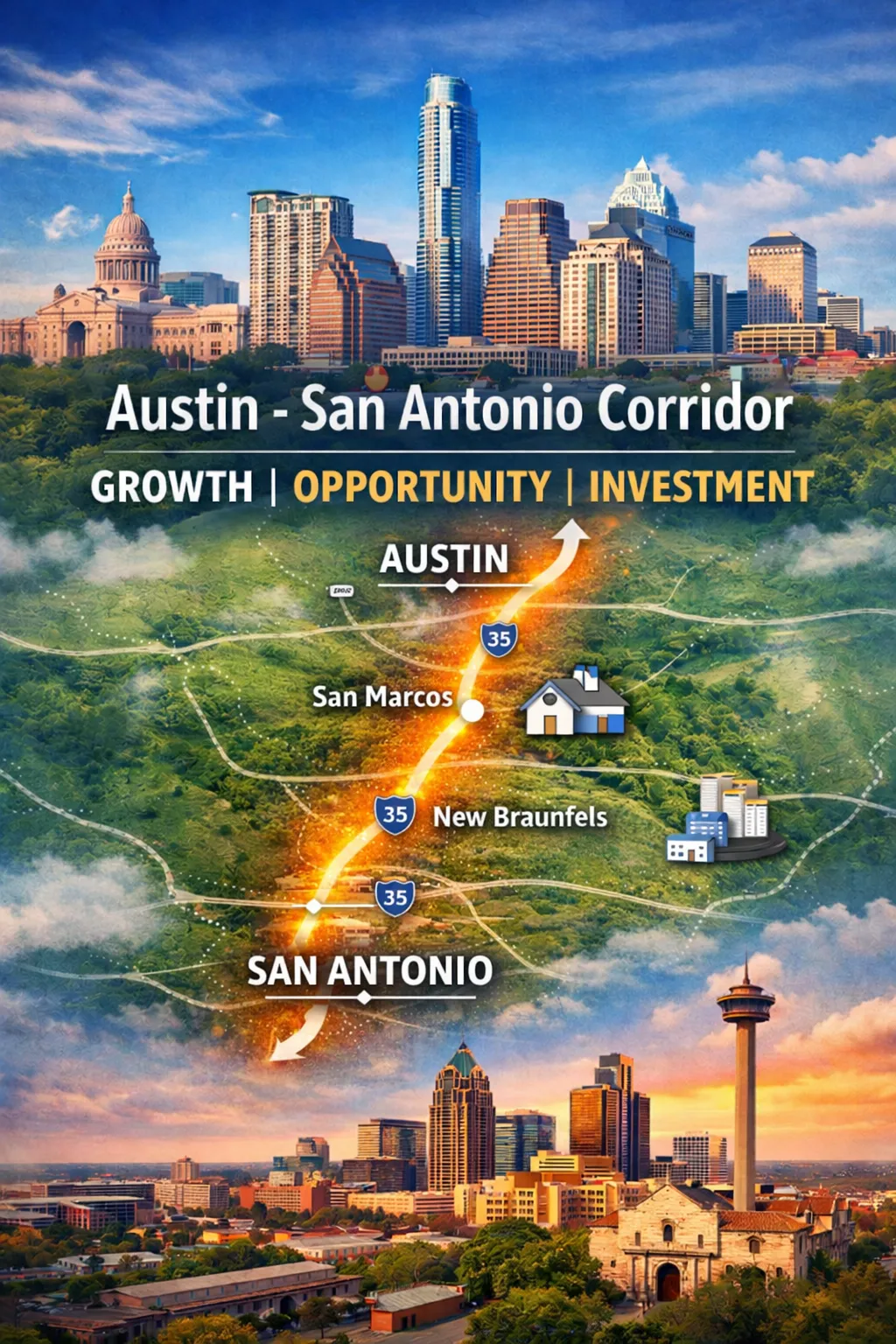
The Central Texas Advantage: Why the Austin–San Antonio Corridor Is an Investor Market
A lot of people treated Central Texas growth as a pandemic story.
The logic went something like: people fled big cities, remote work went mainstream, and Austin/San Antonio became a temporary pressure valve. Now that offices are reopening and the “COVID migration” era is over, maybe things cool off.
But when you look at the data, Central Texas doesn’t read like a one-cycle anomaly. It reads like a region continuing to compound: population growth, job growth, and business expansion that extends beyond the pandemic years. That matters to investors, because durable growth is one of the strongest long-range drivers of housing demand.
At Bella Buyers, we don’t chase headlines. We look for fundamentals that tend to hold up across market cycles. Here’s what the evidence suggests about the Austin–San Antonio corridor — and why it remains a serious investor market.
Central Texas is growing (and the growth isn’t abstract)
If you only follow national headlines, it’s easy to assume Central Texas “already had its moment.” But several of the most telling indicators are post-pandemic and structural, not temporary.
1) The corridor is still adding people — and migration is a major component
The San Antonio–New Braunfels metro area alone added nearly 205,000 people between April 2020 and July 2024, and 59% of that growth came from domestic migration (people moving in from elsewhere in the U.S.).
That matters because migration-driven growth tends to show real preference — people relocating for work, affordability, family networks, quality of life, and long-term opportunity. It’s not just a statistical artifact.
Zooming out, Census reporting shows that while U.S. population growth slowed between July 2024 and June 2025, Texas still grew 1.2% in that window (faster than the national 0.5%). That’s not a “locked-down America” moment — that’s sustained momentum.
2) The growth is spreading outward — not just downtown Austin or San Antonio
One of the strongest “this isn’t temporary” signals is that demand has expanded across the entire corridor, not just in a single hot zip code.
In our county-level breakdown from 2019 to 2024, several “in-between” counties posted major growth:
Bastrop County: ~+29.5% (2019 → 2024)
Comal County: ~+28.9%
Hays County: ~+26.7%
Williamson County: ~+22.9%
That pattern is what you see when a region is maturing into a broader economic zone — households looking for space, affordability, commute access, and community, while still remaining connected to the job hubs.
Texas A&M’s Real Estate Research Center also keeps a dedicated population data hub precisely because population growth is one of the core “macro” drivers of housing need.
3) Central Texas is becoming a “megaregion,” not just two separate cities
A useful mental model here is that Austin and San Antonio aren’t merely adjacent markets anymore — they’re increasingly functioning as a linked corridor.
Local reporting has described the corridor as transforming into one of the fastest-growing regions in the country, with civic leaders and researchers openly discussing how to prepare for that scale of change. This kind of framing usually emerges when growth isn’t just cyclical — it’s pushing into long-range infrastructure, housing, and economic planning.
Investor takeaway: Growth that spreads, persists, and reshapes the region’s geography tends to create long-term housing demand — not just a temporary pricing spike.
Jobs follow growth — and Central Texas is adding them
Population growth doesn’t matter much if the economy can’t support it. But Central Texas continues to add employment in ways that reinforce long-term demand.
Austin: steady job gains even in a more normalized era
Opportunity Austin reports that the Austin MSA added 18,500 jobs (+1.4%) from May 2024 to May 2025, based on Texas Workforce Commission and BLS data.
That’s a helpful “post-pandemic reality check” metric: not a 2021 boom number, but a still-positive year of job creation.
San Antonio: manufacturing and durable employers
San Antonio’s job base has a different flavor than Austin’s — and that’s part of the corridor’s strength. For example, Toyota announced a $531 million investment to expand in San Antonio, bringing 400+ new jobs tied to drivetrain parts production.
Job growth with that kind of capital investment tends to be sticky. People don’t move for a quarter. They move to build a life.
Investor takeaway: When job growth is diversified (tech + healthcare + manufacturing + logistics), rental demand tends to be steadier across cycles.
Supply is loosening in parts of Texas — creating investor-friendly entries
Another reason this market may be more attractive now than a couple of years ago: buyers have more breathing room.
Texas A&M’s January 2026 Texas Housing Insight noted that as of November:
Active inventory was ~5.2 months of supply (up from 4.5 a year earlier)
Average days-on-market for unsold inventory climbed to ~103 days
Sellers were offering larger concessions, with a median price cut of $18,740 (~5%)
This doesn’t mean prices will “crash.” It means the market has shifted away from the most frenzied conditions — and that can improve entry points for disciplined investors. Higher inventory often creates room for:
better negotiation on price
deeper inspections and due diligence
clearer rehab budgeting
creative structuring (where appropriate)
Investor takeaway: Balanced markets often reward patient underwriting more than hot markets do.
Rentals: why San Antonio looks steadier than the hottest markets
On the rental side, Texas A&M’s forecast for the 12 months ending summer 2026 suggests:
Houston and San Antonio may produce ~3–4% rent growth by 2Q 2026
Austin may see further (but lessening) losses over the next 12 months
The point isn’t “Austin bad, San Antonio good.” It’s that San Antonio’s rental market often behaves more steadily, in part because affordability supports wider renter demand, and the city’s growth profile has been less dependent on one narrow boom segment.
Investor takeaway: Steadier rent outlook + affordability tends to support occupancy — which matters more than headlines when you’re underwriting long holds.
What this means for a new real estate investor
If you’re newer to real estate, here’s the practical version:
Demand drivers: Migration and corridor growth are still real, and they’re spreading beyond core city centers.
Entry conditions: Inventory and time-on-market have improved, creating negotiation room and more rational deal flow.
Rental outlook: San Antonio’s forecasted rent trajectory appears steadier than some hotter metros near-term.
Risk discipline still matters: Growth doesn’t remove the need for conservative rehab assumptions, realistic reserves, and careful neighborhood selection.
Start here: If you want to understand how these macro trends translate into specific deal underwriting — pricing, rehab, rent comps, and exit strategy — talk with us or join our list to receive deal briefs and market notes.
Why we pay attention to Central Texas
Central Texas growth isn’t just a pandemic story. The region continues to add people, employers continue to expand, and the corridor itself is increasingly treated as a long-term economic zone — not a temporary boomtown.
At Bella Buyers, we’re not interested in hype cycles. We’re interested in durable demand, disciplined underwriting, and clear communication with our partners.
If you’re looking for a market where fundamentals still justify long-range investing — especially in rentals — the Austin–San Antonio corridor is worth serious attention.


